Free Checklist · 2026 Edition
Hurricane preparedness checklist for 2026.
Hurricane preparedness has two clocks: what you do before the season starts (buy and cut plywood, check your opening protection), and what you do when a watch is issued for your county (fill everything with water, fuel the cars, know your zone). This free printable checklist covers both, sourced from NOAA's own hurricane safety guidance.
Most hurricane checklists collapse two different timelines into one list, which is exactly backwards. The work that takes time: cutting plywood, buying shutters, checking your evacuation zone: has to happen before the season, while you still have time. The work that takes minutes happens when a watch is issued, not before. This checklist is ordered that way on purpose.
This page is one protection out of 130. The manual carries all of them, in order, with the binder forms that go with each. Get the book, $9.99 →
Before hurricane season: the once-a-year checklist
- Know your evacuation zone
Zones are drawn from surge modeling, not distance from the water. Look yours up now and write it on your emergency plan: you won't be able to work it out during an order.
- Choose and document your opening protection
NOAA's own guidance ranks it plainly: "permanent storm shutters offer the best protection for windows." If you're using plywood instead, it must be at least 5/8 inch, exterior grade or marine plywood: interior-grade delaminates when wet: cut to fit and labeled per window before the season.
- Buy fasteners that reach the framing
Screws or lag bolts long enough to penetrate the studs around the opening, not just the siding. Buy them with the plywood, at the same time.
- Check your fourteen-day water store
One gallon per person per day is the federal floor; this book uses two weeks as the planning figure for larger regional events. See our full go bag checklist for the portable version.
- Ask your insurer about mitigation credits
Several states legally require a discount for a documented, mitigated home. It's carrier-specific: ask before the season, not during a claim.
When a watch is issued: the twenty-minute checklist
A watch means conditions are favorable: be ready, and this is when you do the things that take time. A warning means it's happening or imminent: act now, stop preparing.
- Fill every container in the house
Pots, pitchers, both bathtubs, the washing machine, buckets, the cooler. This water is for flushing, washing, and cleaning: where the volume actually goes.
- Fuel every car
And put your documents in one of them.
- Brace the garage door
A double garage door is the largest unsupported surface on most houses and a common structural failure point.
- Install shutters or plywood
All openings: including doors, skylights, and the garage: need protection to earn most mitigation credits. A single unprotected window can void it.
- Charge everything and top up medication
Phones, battery banks, and any prescription buffer you haven't already stocked.
Reading the cone correctly
The hurricane cone shows the probable track of the storm's center: it does not show where the impacts are. Hazards extend far outside it, sometimes hundreds of miles, and the cone is drawn so that roughly two-thirds of historical forecast errors fall inside it, meaning the center itself lands outside the cone about one time in three. Read the surge inundation maps and rainfall forecast instead: rainfall is frequently the deadliest element, and it's unrelated to the storm's category, which describes wind only.
- What is the difference between a hurricane watch and a warning?
- A watch means conditions are favorable and you should be ready: this is when you do time-consuming prep like fueling cars and installing shutters. A warning means the hazard is occurring or imminent: stop preparing, execute your plan.
- What should be on a hurricane preparedness checklist?
- Before the season: your evacuation zone, opening protection cut and labeled, correct fasteners, your water store, and your insurance mitigation credit. When a watch is issued: fill all containers, fuel the cars, brace the garage door, install shutters, and charge devices.
- Does the hurricane cone show where the damage will be?
- No. The cone shows the probable track of the storm's center only. Hazards, including rainfall and surge, routinely extend well outside the cone, and being outside it is not being out of danger.
- Is plywood as good as shutters?
- NOAA's own guidance ranks permanent storm shutters as the best protection, with plywood as the fallback: and only if it's 5/8 inch, exterior grade or marine plywood, cut to fit and labeled per window before the season.
- NOAA National Weather Service, "Hurricane Safety for You and Your Family"
- NHC, "Definition of the NHC Track Forecast Cone"
- Ready.gov, "Water": determining water needs
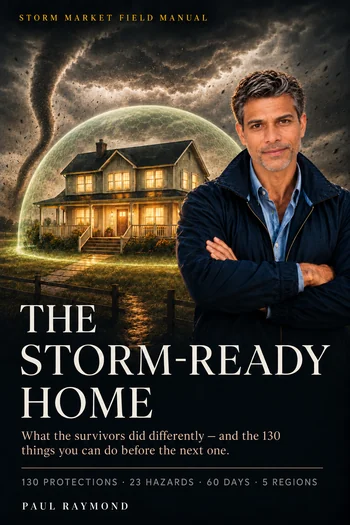
This checklist is the season. The book is every hazard. A 486-page manual with 130 numbered protections across 23 hazard playbooks, including the full opening-protection specification, structural hardening, and a 60-day sequence that orders it for you.
Instant PDF · Pay once, own it forever · 7-day money-back guarantee
Not ready to buy? Get your free state packet instead: your state's specific hazards, agencies, and mitigation rules.
See also: go bag checklist, home inventory for insurance, and your state's hurricane risk in our state guides.
Sources for this page
Get the book
The Storm-Ready Home is a 486-page manual built from post-storm reports: 130 numbered protections, 23 hazard playbooks, the 60-day sequence, and the 61-page printable binder, every figure cited.
The printable pack free
Want all seven checklists as one printable PDF?
Every checklist on this site, laid out for the fridge door, plus three forms from the manual's binder. Emailed to you in one file.
Free. One email. Unsubscribe any time.